
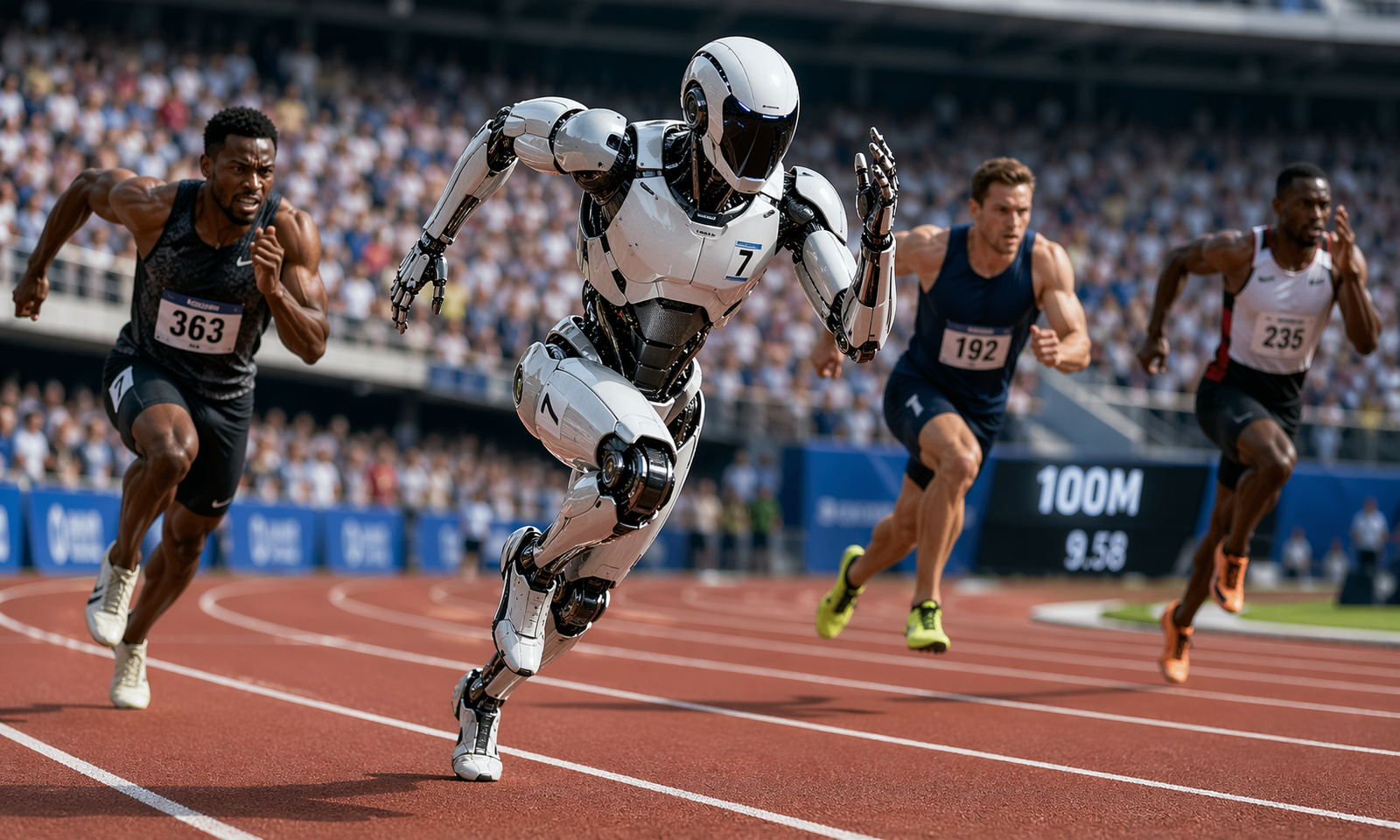
A new era in which artificial intelligence becomes an integral part of the sports world is becoming a reality. Robot runners to machines playing as part of a team, machines are starting to enter into areas that are purely human. This development is not merely a technological one but it calls into question our concept of athleticism, fairness, and competition itself.
The Emergence and Growth of AI Athletes.
The Creation of AI Athletes.
The combination of robotics, machine learning, and biomechanics give rise to AI athletes. The engineers come up with systems that mimic the movements of human beings yet incorporate intelligent decision making facilities. These machines are trained with huge amounts of data which comprise human movement patterns, game strategies and environment information.
AI athletes have an ability to adapt unlike the traditional machines. They make mistakes, they learn and perfect through repetitions and polish their methods with time. This capability to adapt sets them essentially apart from pre-programmed robots.
The fundamental technologies of AI Sports.
The current AI players are based on a system of sophisticated technologies that collaborate with each other. Cameras, sensors, and algorithms process real-time information, provide vision, and collect data in real-time. Reinforcement learning enables machines to trial and error and enhance their performance without being told what to do by human beings.
This amalgamation allows AI athletes to respond quicker than people in numerous scenarios. These systems are programmed to be accurate and fast whether it is the prediction of the path of a ball or the manipulation of the ball in motion.
Live-world Applications Being Introduced.
AI is already going to competitive arenas. Drones racing competitions involve racing drones that are autonomous. Controlled games are being played with robot football players, humanoid robots are learning to run and jump more efficiently.
These illustrations demonstrate the fact that AI athletes are not a far-off speculation- they are being created and tested in a variety of sports.
Athletes who have been driven by AI The main advancements that have been made.
- Existence of machine learning and data processing
- Better balance and mobility of robots.
- Embarkation of computer vision and real-time sensors.
- More investment by technology and sports.
- Increasing popularity of AI-based competitions.
Benefits and Drawbacks of AI in Sport.
Benefits of AI in Performance of Sportspeople.
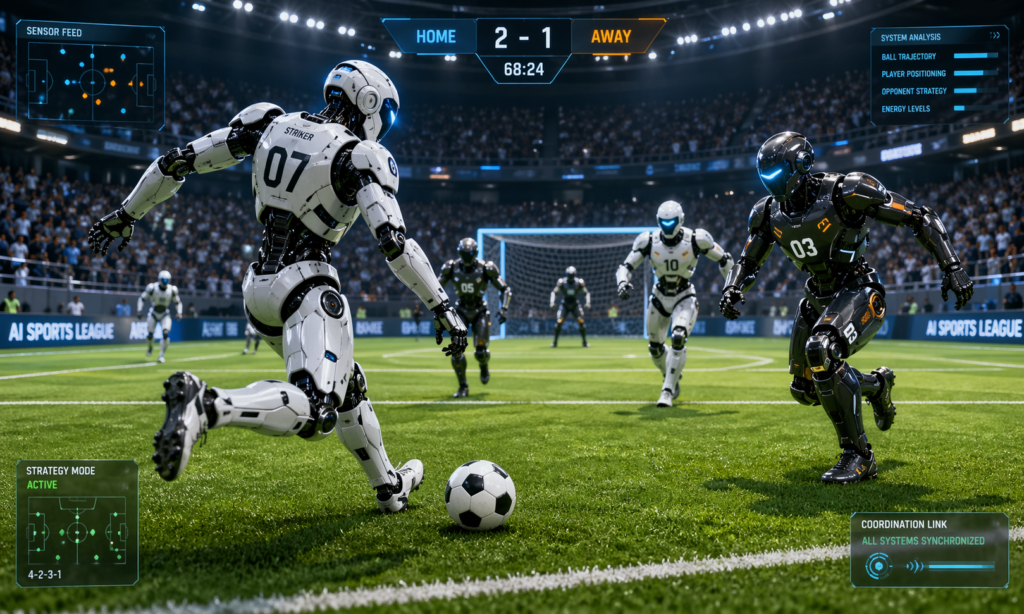
AI athletes introduce some form of uniformity that is not the case with humans. They are not fatigued, pressured or emotionally fluctuated. This enables them to work at a consistent level no matter what the external conditions are.
Moreover, AIs are able to deliver analysis of large volumes of data in real time. This provides them with an upper hand in tactic, response speed and accuracy. With time, they can be further competitive through continuous learning which increases their capabilities.
Competitive and Ethical Issues.
Although these benefits are present, there is a great concern about the emergence of artificial athletes. Fairness is one of the largest issues. Machines designed to perform optimally, can provide an unequal playing field when they are competing with humans.
The other issue is that of identity in sports. Sports have never been about machines, but rather about human strength, endurance and passion. The introduction of AI questions these conventional values and provokes the redefinition of the value of sports.
Influence on the Sports Industry.
Inclusion of AI athletes has the potential to transform the sports world. It can introduce new events, like AI leagues and hybrid events, but might also displace current jobs. Athletes, coaches, and analysts might be required to adjust to a more technologically-focused environment.
Meanwhile, AI would be able to improve the training process to assist human athletes to achieve higher performance levels based on the information provided.
Key Issues and Problems.
- Inquiries regarding the equality in human or AI competition.
- The absence of definite regulations and international norms.
- Possibility of job loss within the sports industry.
- Ethical issues حول the elimination of machine work in favor of human labor.
- Danger of decreasing human and emotional aspects of sports.
Competition between Human and AI.
Hybrid Sports Models
A potential future is that human-AI competitions will be developed in which humans and AI compete individually or as teams. The strategy has the potential of being fair and at the same time adopting innovation.
Invention of New Sports Classes.
Artificial intelligence athletes can result in a completely new type of sport, as esports did. These competitions may be solely based on technological performance and have a different type of audience.
Enhancement of human beings with the help of AI.
Instead of eliminating humans, AI may improve them. Smart training, wearable technology, and AI-based coaching tools can assist athletes in enhancing their performance and abilities.
Entertainment and Appeal to the Audience.
Human vs AI contests would be a huge entertainment. The impossibility of predicting human performance and such accuracy of AI makes it a fascinating spectacle among international viewers.
Influence on Sports Culture.
Changing Fan Expectations
With AI getting increasingly engaged, fans can begin anticipating an increase in the speed and accuracy of gameplay. This may also impact the sporting activities and consumption.
Saving Human Identity in Sports.
In spite of technological advances, human emotion, passion and unpredictability cannot be replaced. It is these attributes that render sports significant and identifiable.
The quest to strike a balance between Tradition and Innovation.
The issue that will arise in the future will be creating a balance between adopting a new technology and maintaining the essence of sports. This equilibrium will dictate the effectiveness with which AI can be implemented in the competitive landscapes.
Conclusion
The use of AI in athletes is changing the world of sports in a manner that could not be envisioned before. They are precise, consistent, and innovative, yet also cast critical questions on the subject of fairness, identity, and what competition is. The human and machine fight will not probably be the headline of the future of sports, but a partnership where the two will co-exist and push the boundaries of performance.
FAQs
1. What are AI athletes?
AI athletes are a robot or software application that is developed to play and compete in sports through artificial intelligence and sophisticated robotics.
2. Will AI athletes win over humans?
The AI athletes have the potential to excel humans in specific domains such as speed, accuracy, and data processing but do not have emotional intelligence and flexibility in unforeseen situations.
3. Will AI take over human athletes?
It’s unlikely. Rather, AI will probably go hand in hand with the human athletes and improve the training and develop new kinds of competitions.
4. Do they have actual competitions for AI athletes?
Yes, the AI drones and robotic systems already compete in the controlled setting and in experimental sports activities.
5. Should AI be allowed to rival human beings?
This remains controversial. It seems that separate categories or hybrid competitions can be the most balanced according to many experts.