
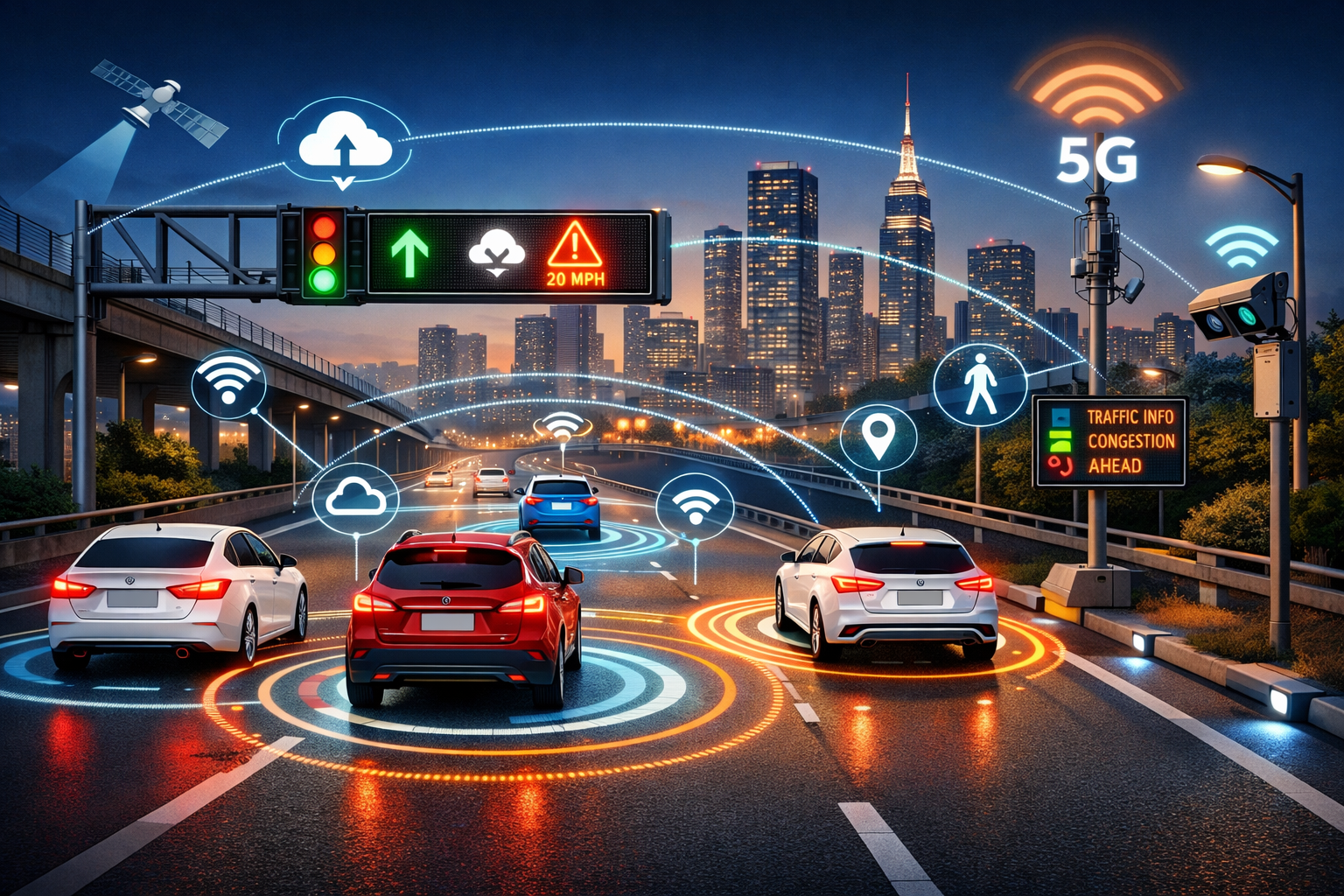
Vehicle-to-Everything (V2X) is a revolutionary technology that is transforming the future of transportation, by making vehicles communicate with their environment in a seamless manner. Its main aim is to establish a networked ecosystem in which cars cease to be independent entities but instead, are members of a smart mobility network. As cities swell, and the roads become increasingly congested with both vehicles and people, V2X offers a promising answer. It’s a technology poised to enhance safety, streamline traffic flow, and contribute to the development of smart transportation networks. This innovation is quickly becoming a cornerstone of both smart city infrastructure and the technologies that underpin self-driving vehicles.
What exactly is V2X technology?
V2X is a cutting-edge communication system that enables the vehicles to communicate in real-time with other parties, such as other vehicles, infrastructure, pedestrians, and cloud networks. It works based on 5G and Dedicated Short-Range Communication (DSRC) methodologies of wireless communication, which provide speedy and low-latency transfer of data. The basic concept of V2X is to expand the scope of a vehicle’s awareness beyond the vehicle sensors, enabling it to be more informed and proactive in its decisions based on the external data that it receives.
V2X Major Elements.
Vehicle-to-Vehicle (V2V)
Vehicle-to-Vehicle communication helps vehicles to exchange important information with other vehicles in terms of speed, position and direction. Such constant data flow assists drivers and automated systems in predicting the possible dangers, minimizing the chances of accidents. It is particularly helpful in the conditions of low visibility like in the blind spots or highways.
How V2X Works
V2X systems are based on a set of sensors, GPS, and communication devices that will be in place in both vehicles and infrastructure. These elements are constantly gathering and sending information related to speed, position, conditions of the roads and traffic. It transmits the information in real-time with nearby vehicles and systems to establish a network of situational awareness that is constantly updated.
Real-Time Communication Process
Whenever a car undertakes a task like sudden braking or change of lanes, the system instantly transmits the information to other cars. The alert system will be used in real-time, giving drivers or autonomous systems extra reaction time, which helps to prevent accidents and enhance general road safety. The rapidity and dependability of this communication is what contributes to V2X as such an essential development in the current transportation.
The advantages of V2X Technology.
Improved Road Safety
V2X will help improve driver awareness by alerting them about any possible dangers like collisions, stops, or blind spots. It keeps the risk of accidents to a minimum, as it minimizes human error and allows responding to it faster.
Reduced Traffic Congestion
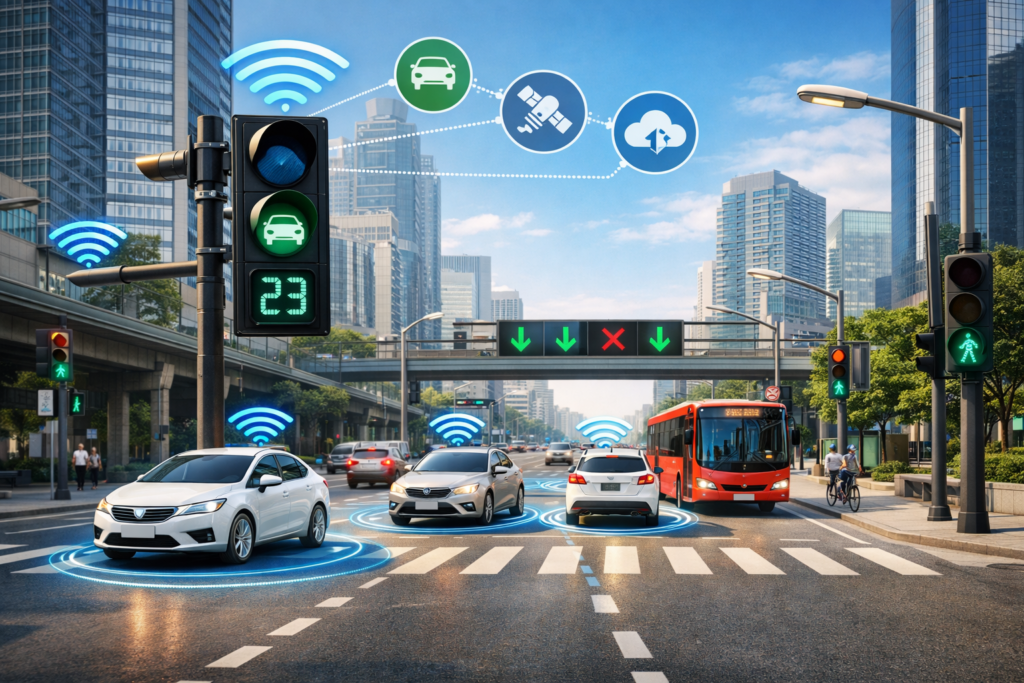
Vehicles will be able to select the best routes and bypass congested places with real-time data sharing. The smart traffic lights can also change in real-time depending on the amount of traffic and result in a faster movement of traffic and a reduction in the time spent on the road.
Enhanced Autonomous Driving
AVs are dependent on high-quality and precise data. V2X also delivers more external data that is supplemented by onboard sensors to enhance the reliability and safety of self-driving.
Efficiency in Fuel and Emission.
The resultant traffic control and less turbulent driving habits will result in fuel economy. This also reduces the emissions of greenhouse gases and this helps in making transportation more sustainable and environmentally friendly.
V2X role in Smart Cities.
Intelligent Traffic Management
V2X in smart cities is used with traffic management systems to optimize vehicle movement. The traffic lights, road sensors and connected vehicles collaborate to minimize congestion and enhance efficiency throughout the transportation system.
Emergency Vehicle Priority
V2X allows ambulances and fire trucks to communicate with the traffic systems in case of an emergency. This enables the traffic lights to adapt automatically, which means that it will respond quicker in emergencies.
Smart Parking Solutions
V2X systems can provide drivers with real-time information on the parking spaces available. This saves time taken in finding a parking space and also reduces redundant traffic in the busy cities.
V2X Implementation challenges.
Infrastructure Requirements
V2X involves a huge investment in intelligent infrastructure such as sensors, communication networks, and modern traffic infrastructure. This may be a significant challenge especially in the developing regions.
Data Security and Privacy.
With vehicles exchanging sensitive information all the time, it is important to have a high level of cybersecurity. Ensuring privacy of users and avoiding data breaches are the most important issues in V2X implementation.
Standardization Issues
Various areas and manufacturers can have different communication standards resulting in compatibility problems. It has to be globally standardized so that it can be used widely.
Network Reliability
V2X relies on high-speed and constant connectivity. The efficiency of real-time communication can be affected by poor network coverage or network latency.
The future of V2X Technology.
Connection with 5G Networks
Implementation of the 5G technology will greatly improve the V2X network, by offering ultra-low latency and high-speed data transfer. This will facilitate more dependable and effective interaction amongst vehicles and the infrastructure.
The growth of Autonomous Vehicles.
With the increasing numbers of autonomous vehicles, V2X will be one of the important components of safe and effective operation. It will give the extrinsic cognizance required in complicated driving situations.
AI-Powered Traffic Systems
V2X data will be analyzed with the help of artificial intelligence to forecast the pattern of traffic and optimize transportation systems. This will result in the smartest and more dynamic urban mobility solutions.
Global Adoption
V2X technology is of great interest to governments and car manufacturers worldwide. Connected mobility is likely to become the new standard as the world shifts to adopting infrastructure and mobility grows swiftly in the global arena.
Conclusion
Vehicle-to-Everything (V2X) is one of the most important innovations that are transforming the way transportation systems work as the vehicles and environment can continuously communicate with each other. It can increase the safety, efficiency, and autonomous driving and smart cities development. With the ever-changing nature of technology, the use of V2X will be an indispensable element of the future mobility, forming an interconnected, smarter, and more sustainable transportation system.
FAQs
1. What is the abbreviation of V2X?
V2X is an abbreviation that means Vehicle-to-Everything, a communication system, which links vehicles and their environment.
2. What does V2X do to enhance the safety of roads?
It gives instant notifications on dangers, enabling drivers and systems to respond to them timely and prevent accidents.
3. V2X: Is it relevant to autonomous vehicles?
Yes, it adds more outside information to the decision making systems of the self-driving systems.
4. What are the technologies of V2X?
V2X involves 5G, DSRC, GPS, sensors, and cloud computing as some of the technologies used to communicate and process data.
5. Is V2X a commonplace in the future?
Yes, as smart cities and interconnected vehicles continue to expand, V2X is likely to be a commonplace in the transportation industry.